
29. Dedications
Days learning piano: 435

What I’m listening to this week
Clair de lune - Debussy
Dedications
This week, a couple friends and I attended a Groupmuse event at a beautiful home in West Seattle. If you’re unfamiliar, Groupmuse is kind of like AirBnb but for live music. People offer their homes for small recitals and concerts, and anyone can attend. At the particular venue, we had a wide view of the Puget Sound, downtown Seattle, and the Olympic mountains. We mingled with other guests while we watched the sunset over ferries crossing the water.
The performer was Andrei Andreev, a young, Russian-born, classically-trained, and internationally-known pianist. It was the greatest piano playing I have ever witnessed. His interpretations of pieces from Beethoven, Chopin, Bach, Debussy, and Rachmaninoff were nothing short of rapturous. Honestly, it was that good.
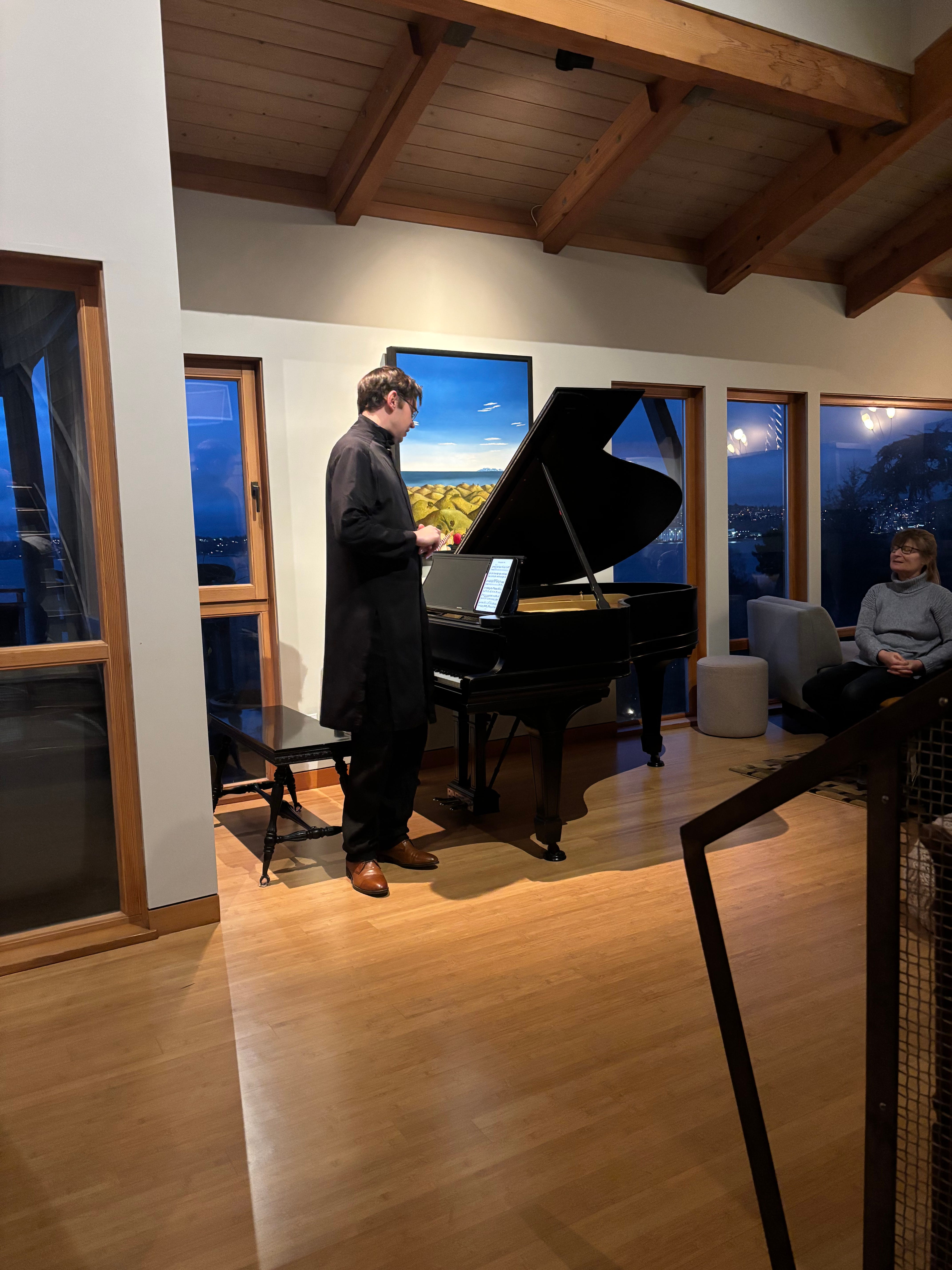
In between pieces, Andrei would share a little about his journey and the historical context of the music. He told us about a recently-departed professor as well, who he credits most of his ability to. In honor of him, Andrei would be playing a specific piece by Beethoven. One that was written as a dedication to Beethoven’s teacher, Joseph Haydn (I think it was Beethoven’s 3rd Piano Sonata, but I can’t remember).
This unnamed professor came up a few more times during the performance, and while Andrei was poised as a cheerful, humble artist, I wondered how his teacher’s passing weighed on him. How it might influence his interpretations. As if this process of honoring enabled him to produce something more sonorous, more sincere. Or maybe it’s something else. Maybe dedications like this are more akin to funerals; more for the living than the dead. In this ritual of dedication, the absent are revived, and it feels like we can commune with them once more, if only for a few minutes. Maybe that’s why Beethoven wrote for Haydn, why Rachmaninoff toured Scriabin’s music, or why Tchaikovsky wrote Elegy for Strings. If it’s materialized just right, maybe we can bring back what is lost.
Luckily for everyone else, I don’t think you have to be a professional musician to access this sentiment.
The following morning, I was doing some chores while listening to a podcast about learning piano. The episode was an interview of a retired woman who picked up piano late in life, but was loving it. I felt some kinship in that. Most of the interview focused on habits, goal setting, and milestones, but one part stood out to me. The woman spoke of a piece her mother played every year around Christmas. She wanted to learn it before her mother passed away, so the tradition may continue without gaps. And that she’s been recording more and more pieces with her phone to capture it all. She really liked the idea that these recordings could be heard long after either of them passed, saying, “music can make us immortal. How amazing is that?”
The interview reminded me of Andrei’s dedication the night before. There’s a through line somewhere in there. Something uniquely human that makes us resist entropy. Something about music being such a powerful medium to do so.
Progress videos
This is a piece I tried to learn how to play a long time ago. It’s not really one I’m actively working on right now, but it felt like it fit the theme.